

By GUILHERME MELETTI YAZBEK
The black box of the Cultural Trust’s Peirce Studio had been shaped into something that overlapped theater and archive. Audiences found themselves arranged in a U-shape, surrounded by an environment that felt both like a set, a cozy living room, and a carefully tended archive collection: boxes labeled illness, sex change, death, addiction; lampshades with warm lights; a warm amber and lavender glow created by Julie Adams’s lighting design; a small television; a ballet barre hung with garments in near-white tones; walls covered in notes and drawings; photographs of artist Greer Lankton pinned to wooden panels; and numerous dolls. Isaac Petti’s set design holds it all together—a space that feels simultaneously intimate and archival, personal and historical. Before the performance began, co-director Jasmine Roth addressed the audience with warmth and care—offering a content warning, explaining that some material would be difficult to hear, and reminding everyone that leaving and returning was entirely welcome. She then mentioned that at certain points in the performance, audience members would be invited to participate. “Consent is really important to us,” she added. “Participate at your will.” It was exactly the right opening gesture: an invitation rather than a demand, establishing the terms of a gathering rather than a performance.

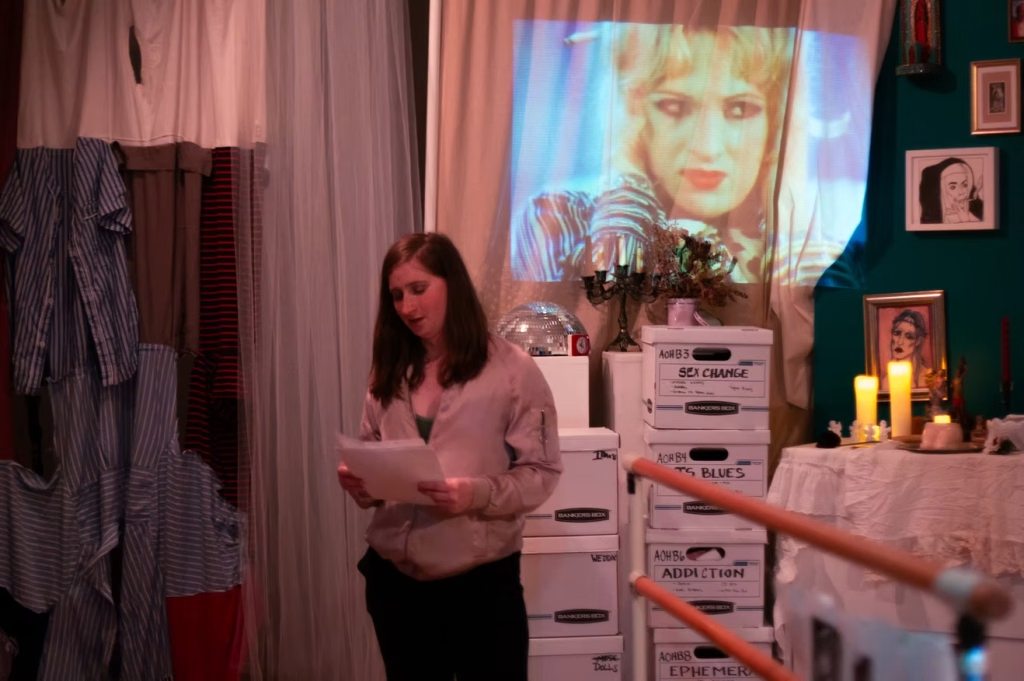
As Others Have Before, created and performed by B Kleymeyer, is built around the life and work of Greer Lankton (1958–1996), one of the most distinctive trans artists to emerge from New York City’s East Village in the 1980s. Born into a Presbyterian minister’s family in Michigan, Lankton studied at the Art Institute of Chicago before receiving her BFA from Pratt Institute in 1981. By then she had already secured her place in the downtown scene—her visceral doll sculptures, drawings, and performances situating her within a constellation of queer allies that included Candy Darling, Peter Hujar, Nan Goldin, and David Wojnarowicz. Lankton’s art was inseparable from her fascination with corporeality: bodies, illness, medication, transformation, the physical experience of being alive in a form that both tormented and obsessed her. She underwent gender-affirming surgery in 1979. Struggling with drug addiction and anorexia throughout her life, she died in 1996 shortly after completing her first full-scale installation at the Mattress Factory in Pittsburgh—It’s All About Me Not You—which afterwards became a permanent part of the museum’s collection. After her death, her family eventually donated thousands of items to the Mattress Factory: drawings, sculptures, sketchbooks, photographs, correspondence, personal journals. It is from this archive—housed here in Pittsburgh, in the city where her last work still lives—that B Kleymeyer built this performance.
Kleymeyer’s presence throughout the evening is one of its greatest assets. Rather than lecturing or embodying Lankton as a character, she shares her stories—and the distinction matters. The tone is intimate and knowledgeable, the kind of conversation you might have with someone who has spent years inside an archive and emerged not with conclusions but with a deep affection for what they found. That intimacy is amplified by the performance’s most inspired formal device: at key moments, Kleymeyer invites audience members to read aloud from letters, diary entries, and documents—passing the material around the U-shaped space, literally and figuratively putting Lankton’s words in other people’s mouths. The result is a genuine sense of community, of looking together at a life rather than being instructed about it. That restraint extends to every layer of the production. The sound design by Ray Morgen—quiet, delicate beds of sound—never pushes the emotion further than the material itself demands. There is no melodrama here, no swelling music to tell us how to feel. The performance trusts its audience, and its subject.
Among the evening’s most memorable sequences is a scene in which a doctor’s approval for Lankton’s gender-affirming surgery is delivered through a ventriloquized puppet—the physician’s voice emerging from an old tape recorder while Kleymeyer animates the figure. It is a moment in which content, form, and Lankton’s own obsessions converge: the doll as vessel, the body as object of institutional scrutiny, the archive made suddenly, strangely alive. Equally striking is the transformation of the ballet barre: used throughout the evening to hold photographs and garments, it is eventually raised ninety degrees to become the support for a long white wedding dress, reshaping the space in a single gesture. And the performance’s closing sequence—in which Kleymeyer names what she herself wants to leave behind (her archive, her memories), quite a poetic moment—lands with a delicate force, drawing her own life into conversation with Lankton’s and asking, implicitly, the same question of everyone in the room.
Not everything in the performance finds its footing with equal confidence. The sheer volume of archival material circulating through the audience—photographs, letters, drawings, documents—is both one of the evening’s most distinctive qualities and its most persistent challenge. There is something genuinely moving about handling Lankton’s actual archive (copies, of course), about the weight of paper that passed through her hands. But the circulation becomes relentless at times, pulling attention away from the scene itself. The camera and tripod occupying the space present a related problem: a thick cable crossing the floor, a tripod occasionally casting shadows on the projection wall, and a device that never quite justifies its presence. The live feed to the small television appears only a couple of times, and the visual logic of the camera’s inclusion remains underdeveloped. The performance has moments that stretch longer than they need to, testing the evening’s rhythm—the pacing occasionally loses the thread it has been carefully building. These are not fatal flaws in a work of this ambition and care. But they are places where the performance’s formal choices have not yet caught up with the richness of its material.
As Others Have Before is, at its core, an act of care—for Lankton’s life, for her archive, for the community that gathers to witness it. There is also something specifically meaningful about a trans artist’s archive being tended and performed by another trans artist—the work of preservation here is not neutral (it never is), but an act of solidarity across time. Kleymeyer has clearly spent a lot of time with this material, and that devotion is palpable in every detail of the space and every choice she makes onstage. What the performance ultimately proposes is something both simple and profound: that the lives of those who came before us are not simply history, but a resource for understanding who we are and who we might yet become. To look at Greer Lankton’s dolls, letters, and diaries is to look at something that still speaks—to questions of body, belonging, chosen family, and the relentless negotiation between the self one is, and the self one is trying to become. These are not questions that belong only to the past. Kleymeyer knows this, and As Others Have Before makes sure we do too. What remains is not simply the record of a life, but the possibility that something of it might pass into other hands, other voices, other lives.
As Others Have Before had its last performance at the Cultural Trust’s Peirce Studio on the afternoon of November 8th, 2026. https://www.bkleymeyer.com/as-others-have-before
Guilherme is a Brazilian theater and dance critic, practitioner, and scholar whose practice moves between criticism, performance studies, and contemporary artistic practices. He is a PhD student in Theatre and Performance Studies at the University of Pittsburgh. www.guilhermeyazbek.com
Categories: Arts and Ideas, Reviews
Leave a Reply Cancel reply